 419-867-8570
Have you ever watched a child turn a cardboard box into a rocket ship, tell an entire story through a drawing or spend an afternoon collecting rocks, leaves and sticks for a project only they fully understand? Children are always communicating. They’re just not always using words to do it.
That idea is at the heart of the 100 languages of children, one of the most beloved concepts within the Reggio Emilia Approach, which posits that children explore, create, communicate and make sense of the world around them in many ways.
And when children are given the freedom to use those hundred languages, we get to see just how much they have to say.
What are the hundred languages of children?
First and foremost, it is important to know that there isn’t a list with exactly 100 languages to check off. The number is instead meant to represent something much bigger: children have seemingly endless ways of expressing what they know, wonder about and imagine.
For example, a child who becomes curious about a bird outside the classroom might explore that interest by:
- Drawing or painting the bird
- Building a nest with natural materials
- Pretending to fly or move like a bird
- Asking questions about where birds live or what they eat
- Creating a story about the bird
- Looking for feathers, nests or other signs of birds outdoors
And those are just a few examples. Each experience gives the child a different way to think, communicate and learn. The 100 languages can also take shape through:
- Building and construction
- Music and sound
- Movement and dance
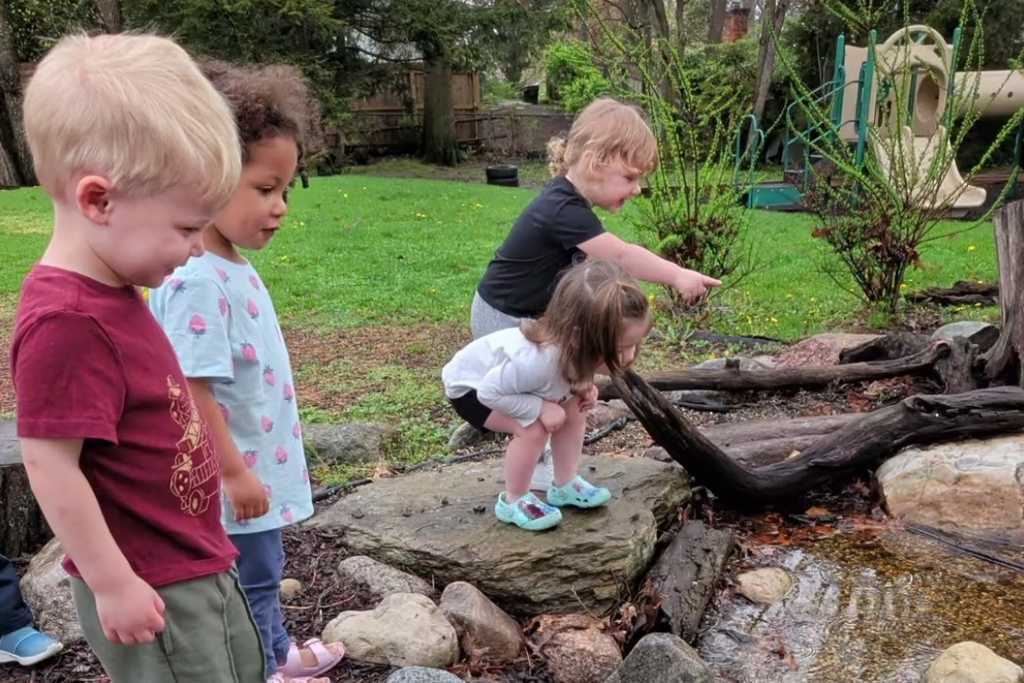
- Nature and outdoor exploration
- Dramatic and imaginative play
- Conversation and storytelling
- Light and shadow
- Clay and other materials
- Numbers, patterns and measurement
- Questions, experiments and observations
And more often than not, several of these “languages” are happening at once.
Where did the idea come from?
The hundred languages are closely connected to educator Loris Malaguzzi, one of the central figures in the development of the Reggio Emilia approach in Reggio Emilia, Italy.
In his “No Way. The Hundred Is There.” poem, Malaguzzi celebrates all the ways children think and create while challenging adults to resist separating things that young learners naturally experience together, like play and work, imagination and reality, or science and creativity.
It’s a beautiful idea, but it’s also a practical one. Children don’t neatly divide their days into “math,” “art,” “science” and “language.” For them, discovery often includes a little bit of everything.
At Children’s Discovery Center, we have modeled our approach to early childhood education on this very principle. Students are encouraged to follow their curiosity, and, in turn, educators act as guides, helping shape each lesson around these very interests.
How projects come about, what means and materials are used to explore, and where the lesson takes them, are all dictated by this fluid approach to learning.
In 2026, we had the opportunity to travel to Reggio Emilia as part of the North American Reggio Emilia Alliance (NAREA) 2026 Study Group. Our staff witnessed this philosophy at its purest and brought back all-new inspiration for our Toledo classrooms. You can read more about that adventure here.
Why do the hundred languages matter?
Children don’t all learn, communicate or explore the world in the same way. The Reggio Emilia philosophy makes room for those differences by giving children many ways to express themselves and investigate their ideas.
- The hundred languages give children more ways to communicate.
Young children often understand more than they can put into words. Drawing, building, movement, dramatic play and other forms of expression give them additional ways to show what they are thinking.
- The hundred languages help children explore ideas more deeply.
When children can revisit an idea in different ways, their understanding can grow. A question might begin with a drawing, then lead to building, experimenting, storytelling or outdoor exploration.
- The hundred languages help children see that their ideas matter.
Teachers can learn a great deal by observing how children create and problem-solve. By listening closely and asking thoughtful questions, teachers show children that their ideas are worth exploring, helping build confidence, curiosity and a love of learning.
When approached with a sincere belief, the 100 languages act as an important foundation for becoming a confident, lifelong learner.
Lay the foundation for your child’s curiosity!
For more than 40 years, Children’s Discovery Center has helped children throughout the Toledo area learn through curiosity, creativity and meaningful relationships. From infant care and preschool to kindergarten Discovery School, our early childhood educators are ready to help your family succeed. Contact us to learn more about our programs or schedule a tour of one of our Toledo-area centers.
Frequently Asked Questions
What does “100 languages of children” mean?
The 100 languages of children refers to the many ways children communicate, learn and express their ideas. The phrase comes from the Reggio Emilia approach and includes everything from talking and drawing to movement, building, dramatic play, music and exploring nature.
Are there really 100 languages in Reggio Emilia?
Not literally. “One hundred” is a metaphor for the countless ways children can think, discover and communicate. There isn’t a set list of methods that children are expected to work through.
Who was Loris Malaguzzi?
Loris Malaguzzi was an Italian educator who played a central role in the development of the Reggio Emilia approach. His poem “No Way. The Hundred Is There.” helped express the philosophy’s belief in children’s many ways of thinking and communicating.
Why are the hundred languages important for young children?
Young children don’t always have the words to explain everything they’re thinking. Giving them different ways to create, move, build, play and investigate allows them to explore ideas more fully and gives teachers another way to understand their thinking.
How does Children’s Discovery Center encourage the hundred languages?
CDC’s Reggio Emilia-inspired classrooms give children opportunities to investigate their interests in many different ways. Teachers observe and listen closely, then offer materials, questions and experiences that can help children’s ideas grow into deeper learning.