 419-867-8570
Key Takeaways
- In the Reggio Emilia approach, the classroom is considered the “third teacher,” using space, materials and experiences to encourage curiosity and discovery.
- Reggio-inspired classrooms feature accessible, open-ended materials that give children opportunities to explore, create and learn through hands-on experiences.
- Classroom spaces are designed to support relationships and collaboration, giving children opportunities to learn with and from one another.
- Reggio Emilia environments evolve with children’s questions and interests, allowing ongoing projects and investigations to help shape the classroom.
- Children’s work and learning documentation become part of the environment, helping make their ideas, discoveries and growth visible.
Next time you enter a preschool classroom, take notice of the layout. How are the tables arranged? What decorates the walls? Is it art, class projects or learning materials? Are there places ot build, create, investigate or simply sit and wonder? In a Reggio Emilia classroom, like those you’ll find at Children’s Discovery Center, every detail and decision adds to our children’s experience. Just like parents and teachers, Reggio Emilia views learning environments as an important teacher.
What does “The Environment as the Third Teacher” mean?
When Reggio Emilia refers to classrooms as “the third teacher,” it means that children can learn not only from adults and one another but also through their interactions with the spaces, materials and experiences around them.
A thoughtfully prepared environment can quietly ask a child:
- What happens if I put these together?
- Why does the light look different over here?
- Can I build this another way?
- What is underneath that rock?
Instead of supplying every answer or directing every activity, the environment creates opportunities for children to investigate.
This approach connects closely with inquiry-based learning, another important part of the Reggio approach. When the two are combined, children are encouraged to notice, question, experiment and build understanding through each experience.
What does a Reggio Emilia classroom look like?
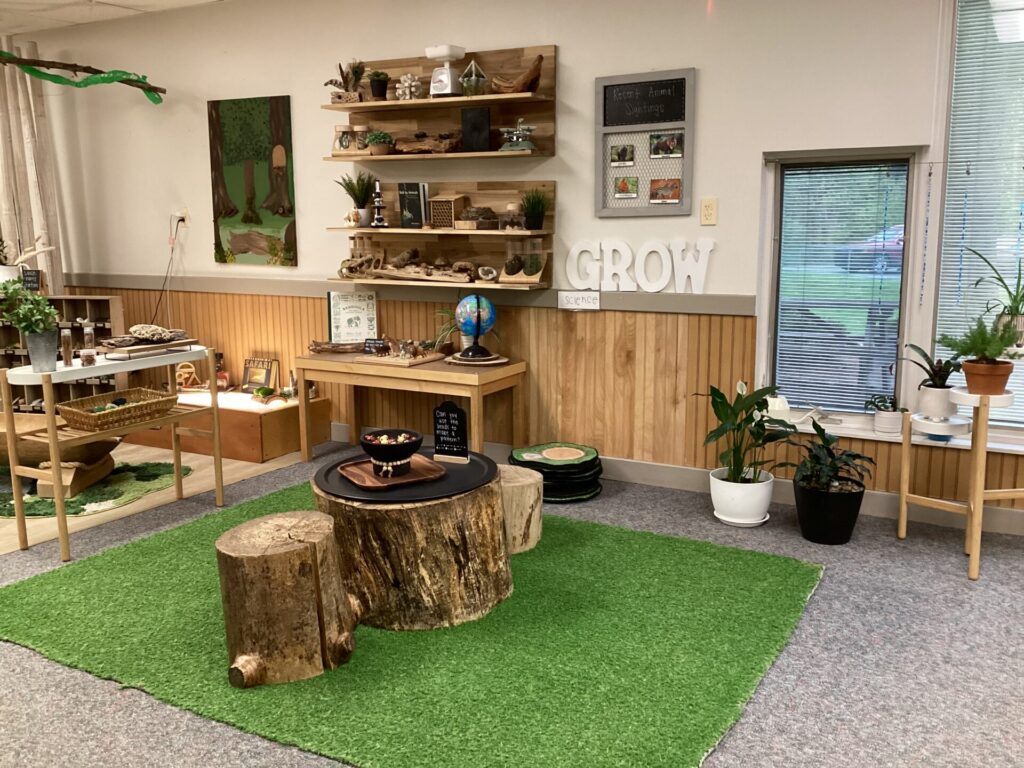
There’s no single blueprint for a Reggio Emilia classroom. In fact, a classroom that responds to the particular children who use it should naturally change over time! Still, many Reggio-inspired environments share a few important characteristics.
- Materials children can see, reach and explore
Young children learn by doing, which is why materials in a Reggio-inspired classroom are intentionally placed where children can easily see and interact with them.
Instead of materials hiding out of sight until the teacher introduces an activity, children may encounter baskets of natural materials, blocks, art supplies, books, loose parts or objects connected to a current classroom investigation. This accessibility supports independence while making room for hands-on learning in preschool.
Take a pine cone, for example. This small piece of nature may open the door to big ideas, becoming part of a sculpture or a piece of a “robot.” A collection of stones might inspire sorting, counting or comparison. Simple blocks could become a city one morning and an animal habitat the next.
Open-ended materials like these are powerful because there’s no “correct” way to use them. The flexibility these objects offer allows children to bring their own ideas to the experience.
- Spaces that invite children to work together
In Reggio Emilia, learning is deeply connected to relationships. Children learn with their teachers, but they also learn with and from their classmates. The same can be said of classroom spaces, which are designed to encourage these interactions by creating places where small groups can build, talk, draw, investigate or problem-solve together. The room helps create opportunities for children to exchange ideas rather than experience learning only as an individual activity.
- Natural light, nature and beauty
A learning environment does not have to be loud or overflowing with decorations to capture a child’s attention. Sometimes, simplicity gives space for creativity and expression.
At Children’s Discovery Center, Reggio-inspired spaces value natural light, calming surroundings and meaningful connections to nature. Windows, plants, wood, stones, shells and other natural materials give children new textures, shapes, patterns and changes to observe.
These elements also become invitations to investigate:
- What happens when sunlight passes through a translucent object?
- Why are two leaves different colors?
- Where do animals go during the winter?
Even something as familiar as light can lead children in unexpected directions. In one of our pre-K class’ featured projects, children investigated light and shadows using sunlight and overhead projectors, turning an everyday phenomenon into a broader classroom exploration.
- A classroom that changes with children’s curiosity
A Reggio-inspired classroom grows and shifts with its children. When teachers notice new interests, they introduce materials, books or experiences that help extend the learning, and parts of the room may also change to support ongoing projects. In this way, the environment responds to learning just as much as its students. At CDC, this evolution can be seen in projects like an ocean study that grew from toy animals into a long-term exploration of marine life, or a hibernation project where children built a bear den to act out what they were learning.
- Work that is part of the environment
Look around a Reggio classroom, and you may notice children’s drawings, photographs, observations or words displayed throughout the space. These decorations double as learning documentation and are an important part of the Reggio Emilia approach because they make learning visible.
As teachers get to know their classrooms, they observe children’s questions, conversations, ideas and creations, then use that information to reflect on where an investigation might go next. Displaying pieces of that process then sends children an important message: Your ideas matter here.
Why does the learning environment matter for preschoolers?
For young children, the classroom is somewhere they spend a significant part of their day. It should feel like a place that belongs to them, not simply a room designed for lessons.
When materials are accessible, children can make choices. When spaces invite collaboration, children can build relationships. When their work and ideas are visible, children can see that their thinking has value. And when their surroundings offer possibilities rather than predetermined answers, children have room to wonder.
That is what the idea of the environment as the third teacher ultimately comes down to: creating spaces that communicate trust in children’s ability to explore, contribute and learn.
See CDC’s environments in action!
The best way to discover the CDC difference is to experience it for yourself! From infant care and preschool to kindergarten Discovery School, our early childhood educators are ready to help your family succeed. Contact us today to schedule a visit to one of our five Toledo-area childcare centers.
Frequently Asked Questions
What does “the environment as the third teacher” mean in Reggio Emilia?
In the Reggio Emilia approach, the environment is considered the “third teacher” because the spaces, materials and experiences around children can actively support learning. Thoughtfully designed classrooms encourage children to explore, make choices, collaborate and follow their curiosity.
What should a Reggio Emilia classroom look like?
A Reggio Emilia classroom is typically welcoming, flexible and designed around children’s interests. Common features include accessible, open-ended materials, natural elements, areas for individual and group exploration and displays that document children’s ideas and learning.
Why are natural materials important in a Reggio-inspired classroom?
Natural materials such as stones, leaves, wood and shells give children opportunities to observe differences in shape, texture, color, weight and pattern. Because these materials can often be explored in many different ways, they also support creativity, problem-solving and hands-on discovery.
How does the Reggio Emilia environment encourage hands-on learning?
Reggio-inspired environments put materials and experiences within children’s reach, giving them opportunities to build, create, experiment and investigate. Instead of only being told about an idea, children can interact with it directly and develop understanding through experience.
Do Reggio Emilia classrooms change throughout the school year?
Yes. Reggio-inspired classrooms are responsive to the children using them. As new questions and interests emerge, teachers may introduce different materials, rearrange spaces or add resources that help children take their investigations further. This allows the environment to evolve alongside their learning.