 419-867-8570
Key Takeaways
- Reggio Emilia and Montessori both view children as capable, active learners, but they use different approaches to encourage independence, curiosity and discovery.
- Montessori learning often centers on purposeful materials, independent work and self-paced progression, while Reggio Emilia emphasizes collaborative, project-based learning shaped by children’s questions and interests.
- In Reggio Emilia classrooms, teachers observe, document and extend children’s thinking, and open-ended materials give children many ways to explore and express their ideas.
- Relationships are central to the Reggio Emilia approach, with children, teachers and families all playing an active role in the learning process.
- Children’s Discovery Center follows a Reggio Emilia-inspired approach that uses curiosity, collaboration and hands-on exploration to help children build knowledge and make meaningful connections.
Are Reggio Emilia and Montessori the same thing? No, although similar, the Reggio Emilia philosophy and Montessori are unique teaching methods that offer their own special benefits for children. Both approaches respect children as capable learners and give them meaningful opportunities to explore. However, parents and students who step into each classroom quickly discover the important differences in how learning takes shape.
Which type of learning environment is best? Each has its own merit! What really matters is understanding how each philosophy approaches teachers, materials and relationships. Once you know this, your child’s natural curiosity can help you decide which environment feels most like home.
At Children’s Discovery Center, we’re proud to offer Reggio Emilia-inspired curriculum that helps our young students grow each day!
What is the difference between Montessori and Reggio Emilia?
Montessori and Reggio Emilia share a respect for children’s abilities, but the philosophies are not interchangeable.
The Montessori method was developed by Italian physician and educator Maria Montessori. In these classrooms, children are often provided a carefully prepared environment in which they can choose from purposeful activities and materials, work independently and progress at their own pace. Montessori teachers introduce these materials, and then give children room to practice and explore them independently.
The Reggio Emilia approach originated in Reggio Emilia, Italy, and grew through the work of educator Loris Malaguzzi, families and the surrounding community. It views children as capable, curious learners who build knowledge through relationships with other children, teachers, families and their environment.
In Reggio Emilia classrooms, children are encouraged to investigate their ideas through what Reggio educators describe as the “hundred languages,” or the many different ways children think, communicate and create.
During Spring 2026, members of CDC leadership had the incredible opportunity to travel to Reggio Emilia, Italy, to participate in the North American Reggio Emilia Alliance (NAREA) 2026 Study Group, where we spent a week diving deeper into the philosophy and learning environments that have shaped our approach. (You can read all about that here!)
Here’s a quick look at how the two compare:
| Montessori | Reggio Emilia | |
| Learning Style | Often individual and self-paced | Collaborative, exploratory and project-based |
| Teacher’s Role | Observes, guides and introduces purposeful materials | Observes, listens, documents and learns alongside children |
| Curriculum | Learning progresses through prepared activities and materials | Projects and experiences evolve from children’s questions, interests and theories |
| Materials | Specific Montessori materials designed for particular skills and concepts | Open-ended materials that can be explored and represented in many ways |
| Classroom Environment | Carefully prepared to encourage order, concentration and independence | Considered an educator itself and designed to inspire relationships, research and discovery |
| Creative Expression | Available alongside other areas of learning | Central to learning through the “hundred languages” |
| Collaboration | Independence is strongly encouraged, with community also valued | Relationships, group learning and shared discovery are central |
| Family Involvement | Parents support the Montessori philosophy and school community | Families are active participants in the educational experience |
Take a closer look at Reggio Emilia and Montessori.
Both approaches give children more agency than a strictly teacher-directed classroom. The biggest differences are found in how that agency is encouraged.
- Reggio learning can begin with a question.
In a Montessori classroom, children generally choose activities from a thoughtfully prepared selection of materials. Each material has an educational purpose, and after an introduction from the teacher, children are encouraged to work with it independently.
Meanwhile, Reggio Emilia-inspired learning can begin with a single question, and projects can take many different paths and spark weeks of discovery.
For example… imagine a group of children who spot a caterpillar outside. One child wonders where it’s going. Another student wants to know what it eats. Before long, the class might be drawing caterpillars, searching outdoors, reading books, working with clay and watching a real caterpillar change before their eyes.
Reggio Emilia lessons don’t have a predetermined destination. Teachers listen closely to children’s ideas and create opportunities to investigate them further. From exploring the Polar regions to experimenting with light and shadow, each featured project in our blog is a look into how our young discoverers explore the world around them.
- Collaboration also plays a different role.
Montessori encourages children to become capable, independent learners. Its mixed-age classrooms also provide opportunities for children to learn alongside and from one another.
In Reggio Emilia classrooms, relationships also take on a central and special role in the learning process. Children regularly investigate ideas together, compare theories, solve problems and build on one another’s thinking. Teachers and families are part of those relationships, too, so it is important to build strong parent-teacher relationships.
Learning becomes something we create together, and at CDC, that may look like a group gathered around a project table, each child contributing a different idea about what to build next.
- Different materials invite different kinds of discovery.
A Montessori environment commonly features specialized materials designed to introduce or reinforce particular concepts. Children learn how to use those materials and can return to them independently as their abilities grow.
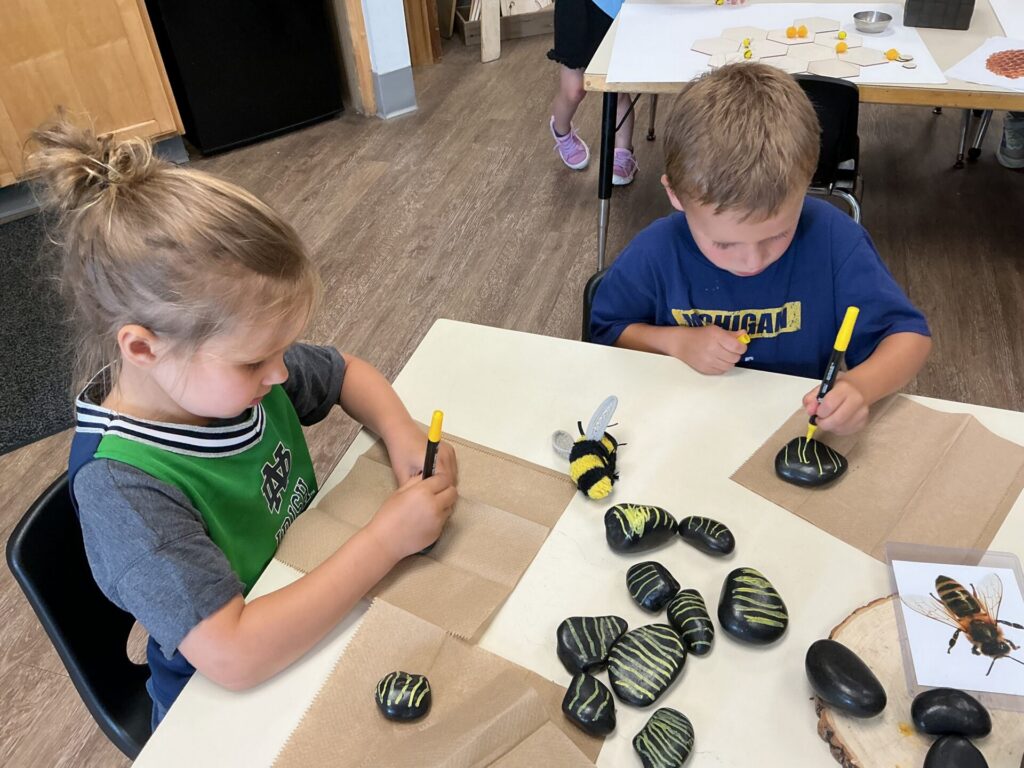
Reggio-inspired classrooms make extensive use of open-ended materials. Clay, paint, wire, blocks, natural objects, light and natural and recycled materials can become tools for investigating an idea. There may not be one “right” thing to make in a Reggio Emilia lesson. Instead, the value is in what children notice, wonder about and discover along the way.
- Teachers follow the learning as it unfolds.
Neither approach sees a teacher simply standing at the front of a classroom delivering information. In Montessori, teachers carefully prepare the environment, observe children and introduce materials and activities when children are ready for them. Reggio educators also observe closely, but documentation and collaboration play particularly important roles. Teachers record children’s words, questions, artwork and discoveries so they can reflect on the learning taking place and consider where an investigation might go next.
What do Reggio Emilia and Montessori have in common?
It’s just as important to understand the similarities as it is the differences when choosing the right fit learning environment for your child.
Reggio Emilia and Montessori share more similarities than you may realize:
- Both originated in Italy.
- Both challenged more traditional ideas about what young children are capable of.
- Both respect children as active learners.
- Both value thoughtfully designed environments.
- Both give children meaningful choices in their learning.
- Neither believes young children should spend their days simply sitting and listening.
And both recognize something we see every day at CDC: children are highly capable when they’re given the space and support to explore.
Why does Children’s Discovery Center follow the Reggio Emilia approach?
At Children’s Discovery Center, we believe curiosity can lead to incredible things: discovery, growth, community and so much more.
That’s one of the reasons the Reggio Emilia approach has been such an important part of our educational philosophy. Rather than deciding where every lesson must end before it begins, our teachers pay attention to what captures children’s imaginations and help them dig deeper.
A fascination with shadows can become an investigation of light, color and prisms. Questions about animals can grow into a classroom exploration of habitats. A child’s interest in making marks can open new opportunities for art, communication and early writing. These projects bring together science, language, art, movement, problem-solving and plenty of hands-on discovery without separating learning from the joy of being a child.
The Reggio philosophy also reflects something deeply important to our community: relationships. Children don’t learn in isolation. They learn alongside friends, with caring teachers and with families who know them best. And, to us, that is the true power of the Reggio Emilia approach.
Discover More During Preschool at CDC
Want to explore the philosophy further? Explore all that CDC has to offer! From infant care and preschool to kindergarten Discovery School, our early childhood educators are ready to help your family succeed. Contact us today to schedule a visit to one of our five Toledo-area childcare centers.
Frequently Asked Questions
What is the main difference between Montessori and Reggio Emilia?
Both approaches respect children as active learners, but they organize learning differently. Montessori generally emphasizes independence, self-paced work and purposeful Montessori materials within a prepared environment. Reggio Emilia places greater emphasis on relationships, collaborative projects, open-ended materials and investigations that develop from children’s questions and interests.
How does Reggio Emilia differ from Montessori in the classroom?
A Montessori classroom typically gives children opportunities to independently choose and work with carefully prepared learning materials. In a Reggio-inspired classroom, you are more likely to see children investigating a shared question through discussion, art, construction, dramatic play and other forms of expression. Both approaches value children’s choices, but the learning experiences can look quite different.
Which is better, Reggio Emilia or Montessori?
Neither approach is universally better. The right choice depends on your child and what your family values in an early learning environment. Families drawn to collaboration, creativity, relationships and projects that follow children’s interests may find themselves particularly comfortable in a Reggio Emilia-inspired program.
Is Reggio Emilia child-led?
Yes, although “child-led” doesn’t mean children are left to learn entirely on their own. Reggio educators listen carefully to children’s questions and theories, then intentionally create environments and experiences that help them investigate those ideas further. Learning is constructed through interactions among children, educators, families and their surroundings.
What is the Reggio Emilia approach?
The Reggio Emilia approach is an educational philosophy that views children as capable learners with many ways of thinking, communicating and expressing ideas. It emphasizes relationships, participation, educational documentation, thoughtfully designed environments and learning through research and exploration.